
Cumberland Federal Release Routes
Cumberland County lies in the federal Middle District of Tennessee. A Cumberland-linked defendant can move through federal court and U.S. Marshals custody without creating a Tennessee Department of Correction record. USMS manages federal pretrial custody, transport, writs, and court security. The Bureau of Prisons becomes the main public locator for someone who entered sentenced federal prison custody.
These routes can overlap. A person may leave a county contract placement but remain in federal custody. A BOP release can also be followed by federal supervised release, another jurisdiction's custody, or a detainer. The federal docket explains bond, dismissal, sentence, and later supervision orders. A locator answers the narrower custody question.
Search BOP Release Records
The official BOP Inmate Locator covers federal prisoners from 1982 onward. Search by BOP register, DCDC, FBI, or INS number when available. A name route permits an optional middle name, race, age, and sex. Results may show the register number, age, race, sex, release date, and location or status.
- Use a federal identifying number when legitimately known.
- Otherwise enter the full name and narrow the result with available descriptors.
- Compare the register number and identity fields before relying on a match.
- Read whether the date is past, future, or unknown.
- Check the federal docket when the post-custody legal status matters.
| BOP display | Careful reading |
|---|---|
| Past release date, no BOP facility | Supports that BOP custody ended on the listed date |
| Released | No longer in BOP custody, not proof of no other custody |
| Not in BOP Custody | Outside BOP, possibly elsewhere or on supervision |
| Future date | A projected date that may change |
| UNKNOWN | BOP has not stated a determinate date |
Federal sentence computations can change, including through First Step Act recalculation. Never treat a future date as an actual event. For records older than the locator's modern coverage, the National Archives may be the right historical route.
Read the Federal Locator
BOP's official locator status explanation defines the limits of “Released” and “Not in BOP Custody.”
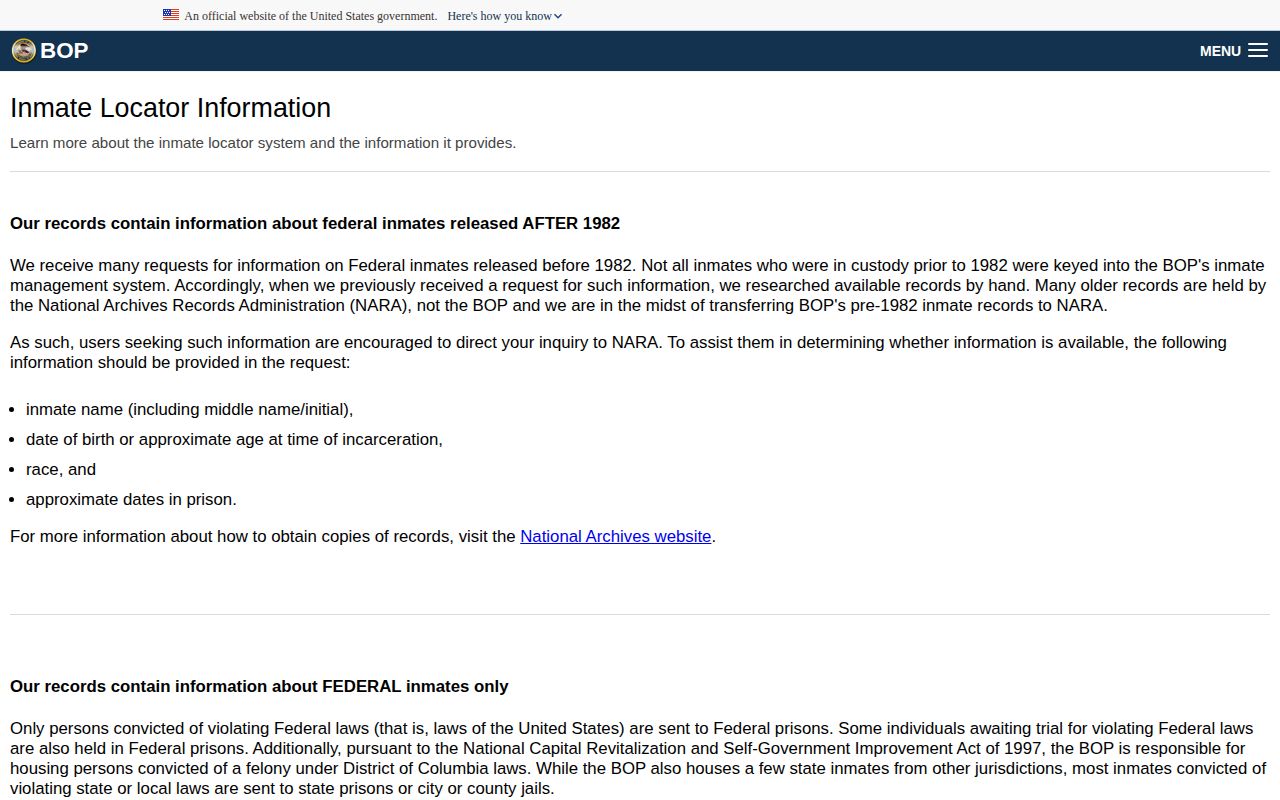
The displayed date must be read with its location or status. It does not establish whether federal supervised release, a state case, or another detainer remained after BOP custody ended.
Check USMS Custody Changes
The U.S. Marshals Service has no public historical released-person locator. That makes the federal docket and district contact essential for a person who never entered BOP custody. A bond order, dismissal, detention order, sentence, or writ can explain why USMS custody changed, though the docket may not show the exact hour of a physical handoff.
The Middle District of Tennessee publishes district and courthouse information. Its Cookeville location is relevant to Cumberland County and is occupied only during term of court. Call before appearing. Provide the federal case number and full name if asking which office can route a custody-record inquiry.
U.S. Marshals Service, Middle District of TennesseeDistrict headquarters: 615-750-1434
Cookeville courthouse location
9 East Broad Street, Unit 201
Cookeville, TN 38501
Phone: 931-528-7755
Occupied only during term of court
Federal Release Verification Steps
Start with the custodian that most likely held the person. BOP is appropriate after a federal prison sentence. USMS and the court are appropriate for pretrial detention, transport, or a federal writ. If a county jail record names a federal agency, it only proves departure from the county booking when the release timestamp is populated.
- Identify the federal case or agency from the court or county record.
- Search BOP by register number or exact identity.
- Read the release date with the BOP location or status.
- Search the federal docket for the order that explains detention, bond, sentence, or supervision.
- Contact the Middle District when USMS custody is the unresolved part.
A two-source match is strongest. Pair BOP's past release status with the federal docket. For a USMS pretrial departure, pair the court order with the district's custody information when available. The Cumberland released-inmate search covers the separate county record path when federal custody began with a local booking.
Federal Status After Release
“Not in BOP Custody” is deliberately narrow. It can coexist with supervised release, a pending court duty, immigration custody, state custody, or another agency hold. Supervised release is a court-ordered period in the community after imprisonment. It is not parole and does not mean the federal case vanished.
- USMS custody
- Federal pretrial, transport, writ, and court-related custody handled by the Marshals Service.
- BOP custody
- Federal sentenced-prison custody recorded by the Bureau of Prisons.
- Supervised release
- Federal court supervision in the community after imprisonment.
- Detainer
- A basis for another agency to take or continue custody.
ICE is a separate civil immigration custodian. A known transfer there should be checked through the ICE locator within its stated time range. No authoritative source found a Cumberland County ICE contract, so immigration custody should not be assumed from a federal case alone.
Note: Record the date of every live search because BOP status, location, and projected dates can change.
See BOP Search Inputs
The official BOP locator displays the number and name routes used to search federal custody history.
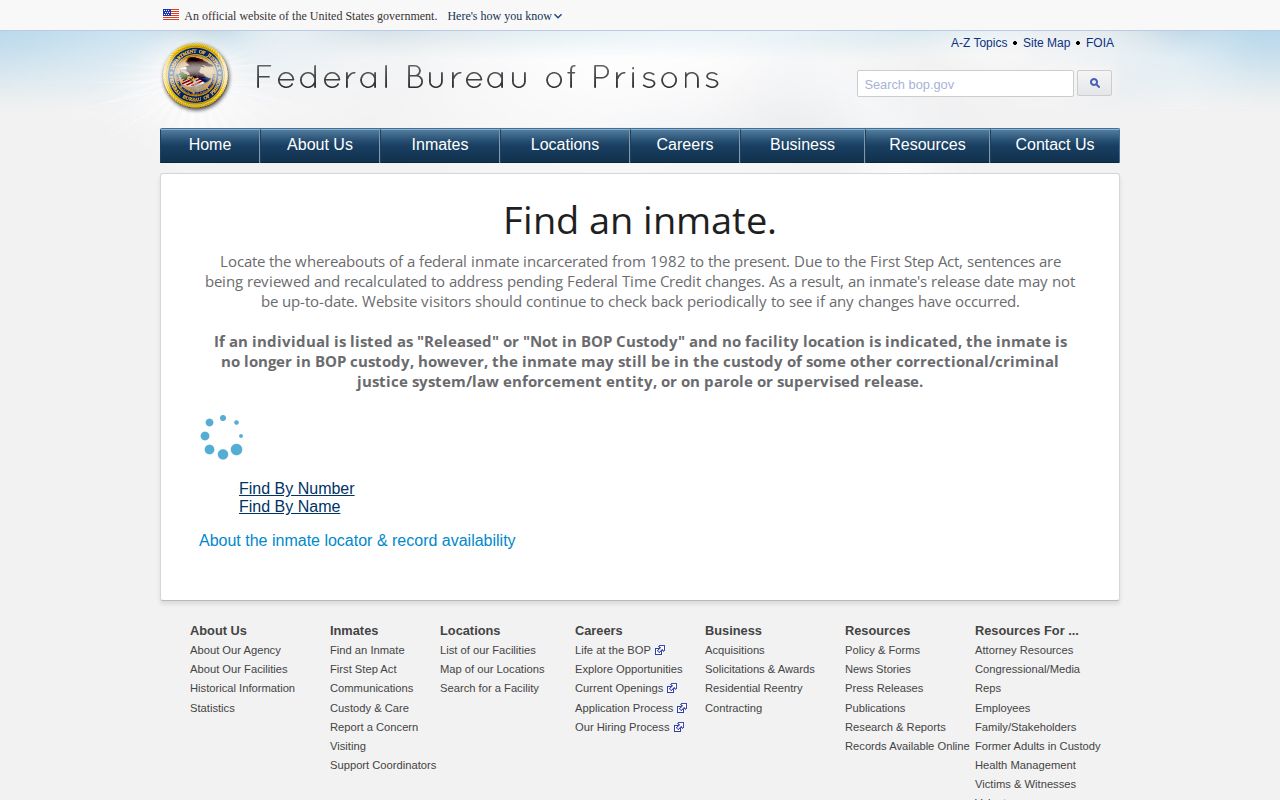
The image shows where a search begins. A live matching result and federal case record remain necessary to interpret the release accurately.
Request Federal Release Records
When a locator result is not enough, identify the agency record that answers the narrow question. BOP can address sentenced-prison custody and sentence computation. The federal court file can supply the judgment, detention or bond order, sentence, and supervised-release terms. USMS can route questions tied to pretrial custody or transport, though it does not offer a public person-by-person history tool.
Give the federal case number or BOP register number when available. State the date range and ask for the exact release, transfer, or custody record. For a historical federal prison record outside the modern locator range, National Archives holdings may be relevant. Each office can apply its own access and redaction rules, so ask for the proper process and current cost information.
Resolve Federal Record Conflicts
A county release, USMS event, BOP result, and court order can refer to different stages. Put them in time order. The Cumberland timestamp may show departure from local custody, the Marshals record may show a federal handoff, and BOP may begin only after sentencing and designation. None cancels the others.
If dates or statuses conflict, note the agency and access date for each. Ask the owner of the disputed field for its underlying record. Do not convert an unknown BOP date into release, or a past BOP date into proof that no other agency held the person next.
Cumberland Federal Case Timeline
A useful federal timeline begins with the court case. Note appearance, detention or bond order, judgment, sentence, BOP designation, release date, and supervised-release term. Not every person passes through each stage. A defendant released before sentencing may never create BOP history, while a sentenced person can have both USMS and BOP records.
County custody may appear first when a federal writ leads to a handoff. The Cumberland release card only closes that booking. Use released-to data and the federal docket to trace the next step. If BOP later shows a past date, that is a separate prison event.
The docket explains the court's action. BOP supplies sentenced-prison status. USMS routes pretrial questions but has no historical public locator. A sound answer often needs all three roles understood.
Correct Federal Custody Records
Confirm which agency owns the disputed entry. BOP owns its locator and prison computation. The court owns docket and judgment entries. USMS handles its custody records. A Cumberland release field belongs to CCSO even when a federal handoff followed.
Use the BOP register or federal case number. State the exact date or status that appears wrong and supply an official conflicting record. Ask for the proper correction route. One federal office cannot amend another office's source record.
Keep an access date with each locator result.