
Cumberland Scheduled and Actual Release
Four dates or statuses often appear near one another, yet each answers a different question. Release Eligibility Date, or RED, is the earliest point at which an eligible state offender may be considered for parole or another release mechanism. A parole hearing or decision belongs to the Board process. Sentence expiration is the calculated end of the sentence, subject to lawful adjustments. Actual release is the event recorded when a custodian lets the person leave or transfers custody.
Cumberland County Jail cards can display an exact Release Date and time. TDOC Policy 511.03 uses the labels Release Eligibility and Sentence Expires on its release authorization. FOIL promises sentence and release information, but its public explanation does not promise a field literally named Projected Release Date. Copy the live label exactly. Never rename RED as a guaranteed departure date.
Scheduled versus actual: A future eligibility or expiration date predicts a legal milestone; only an agency release entry or authorization confirms the event.
- Release eligibility
- The first lawful point for consideration under the governing sentence rules.
- Sentence expiration
- The computed end of the sentence, subject to valid changes.
- Actual release
- The recorded departure from one custodian.
- Discharge
- The formal end of custody or supervision, which may occur after physical release.
Cumberland Custody Controls the Lookup
A pretrial Cumberland detainee usually has no sentence-based projected date. Release depends on bond, a court order, disposition, or another event that has not yet occurred. The court docket may show the legal authority, while the Cumberland County Sheriff's Office records the actual jail departure. A blank release field on the jail portal still describes a recent intake or current inmate, not a future release promise.
A person serving a local county sentence needs the official jail calculation and judgment. No Cumberland-specific good-time formula was found, so do not estimate one. A person committed to TDOC follows the statewide sentence system even if first held in the county jail. TDOC has no prison in Cumberland County. Placement at an intake or other prison does not change the statewide FOIL search route.
| Custody type | Best date source | What confirms release |
|---|---|---|
| Pretrial county jail | Court order and bond record | Populated CCSO Release Date or release sheet |
| Local county sentence | Judgment and CCSO calculation | CCSO actual release record |
| TDOC felony sentence | FOIL plus TDOC sentence record | FOIL actual status and release authorization |
| Federal custody | BOP locator or federal docket | BOP past release entry and court record |
Find Cumberland Projected Release Dates
Begin with the custodian, not with a date copied from an unknown source. The TDOC FOIL search covers felony offenders currently or formerly in state custody or supervision. It does not cover every person booked and released on a local matter. An identifier is safer than a name alone.
- Identify whether the person is in Cumberland County Jail, TDOC custody, federal custody, or another system.
- For TDOC, search by TOMIS/TDOC number or SID when known. Otherwise search by last and first name, then compare identifiers.
- Read the status first. Incarcerated means state custody; parole or probation means community supervision; inactive means no active TDOC custody or supervision.
- Copy the exact displayed labels and the access date. Keep Release Eligibility, Sentence Expires, hearing dates, and actual release information separate.
- For a county sentence, ask CCSO for its official calculation and obtain the judgment from the responsible court.
- Confirm a completed event with the release record or authorization. If another agency took custody, treat the date as a transfer.
FOIL may show a photo, location, offense, sentence, parole-hearing status, and release information. TDOC warns that information may not be complete, current, or accurate. A precise timing question therefore belongs with the record custodian, especially when a detainer, new order, or credit dispute may apply.
The official FOIL search screen shows the name, alias, race, TDOC/TOMIS, and SID routes used before a record's dates can be reviewed.
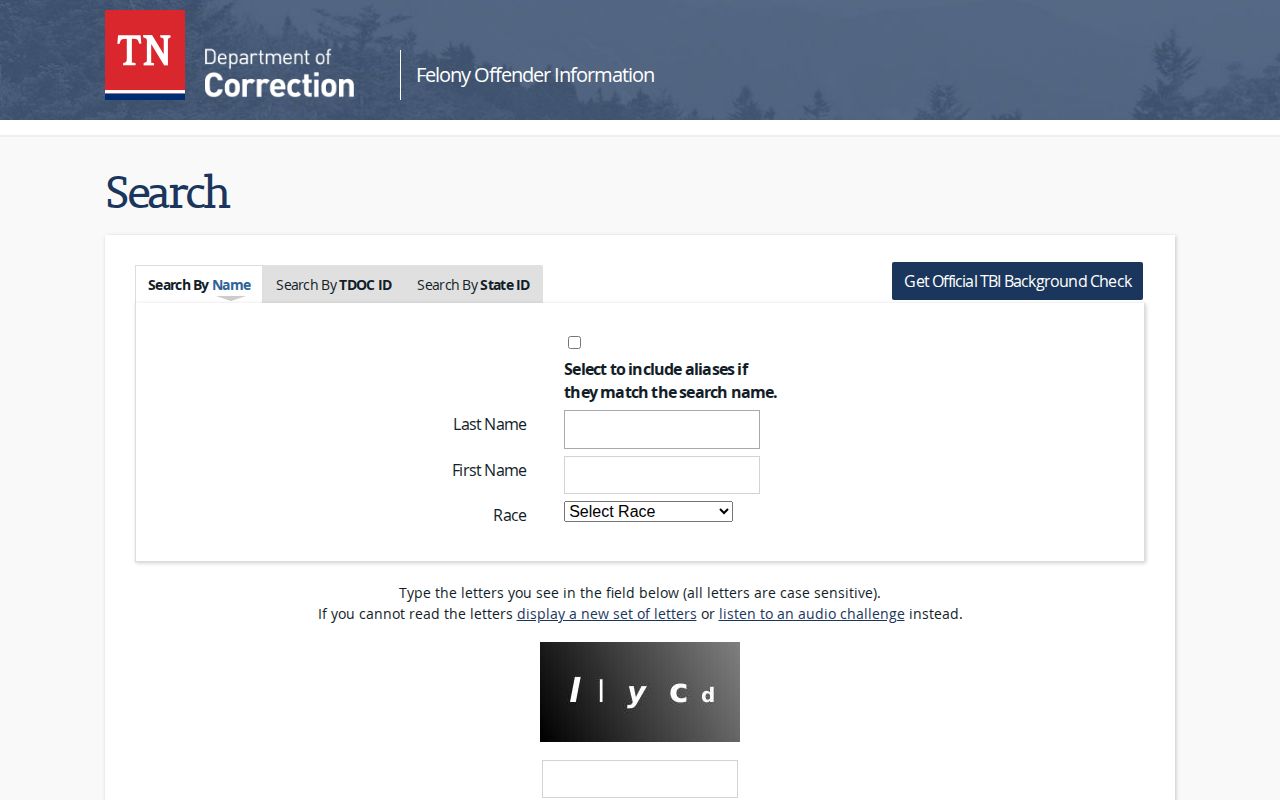
The search screen identifies a possible state record; only the matched detail and TDOC release documentation can distinguish eligibility, expiration, and an actual release.
Note: Record the lookup date because FOIL, jail, court, and notification data can change.
Cumberland Release Credits and Sentencing
Tennessee's truth-in-sentencing legislation amended Tenn. Code Ann. §40-35-501 with offense- and date-specific rules. Some listed offenses can require 100 percent service. Others fall under an 85 percent regime. Later changes apply to certain offenses committed on or after July 1, 2024. There is no sound universal rule that Tennessee inmates serve 85 percent.
The correct result depends on the offense, offense date, judgment, range or classification, sentence, and current statutory subsection. For certain subsection (y) offenses committed from July 1, 2021 through June 30, 2024, the legislative text describes 85 percent less earned and retained credits, with a floor that credits cannot reduce below 70 percent. For covered offenses on or after July 1, 2024, the text describes 85 percent undiminished by credits, along with further provisions. Other sentence classes follow other rules.
Tenn. Code Ann. §41-21-236 governs sentence reduction credits. Credits are earned, retained, documented, and discretionary under program and behavior rules. They can be forfeited or restored through lawful procedures. Some affect eligibility while other statutes prevent them from cutting a minimum term or sentence expiration. Do not build an unofficial date from sentence length alone.
The local-jail part of §41-21-236 can extend good-institutional-behavior credit rules to specified felony offenders serving at least one year in a jail or workhouse. It does not prove that Cumberland has one formula for all local inmates. CCSO should supply the official county calculation.
Cumberland Release Dates Can Change
A projected date is a calculation based on facts and law known at that point. Later conduct, a corrected judgment, a new court order, or another agency's claim can change what happens. Some changes alter eligibility. Others leave the sentence date intact but change where the person goes.
| Factor | Possible effect | Record to verify |
|---|---|---|
| Earned or lost credits | May change eligibility where statute permits | TDOC sentence calculation |
| Detainer or hold | Release may become transfer to another custodian | Release authorization and receiving record |
| Court order or corrected judgment | May alter sentence authority or timing | Certified court order |
| Parole grant or denial | May permit conditional release or continue confinement | Board decision and TDOC release record |
| Approved release plan | May be required before physical parole release | TDOC or Board record |
| New pending charge | May block or redirect a release | Court and agency records |
A detainer is a request by another agency to hold or take the person. If it is active, the listed release date may be the day Cumberland or TDOC hands the person to that agency. It is not necessarily a return to the community.
Cumberland Release Mechanisms Need Context
TDOC describes determinate release for qualifying felony sentences of at least one year and no more than two years after at least 30 percent has been served, with a statutory notice and objection process under §40-35-501. The statute and judgment still control any individual case. A short sentence alone does not prove that this route applies.
Mandatory reentry supervision under Tenn. Code Ann. §40-35-506 applies to qualifying felony offenses on or after July 1, 2021. Eligibility can depend on time left, detainers, pending charges, custody, and disciplinary factors. Some eligible people may serve the final year in the community. Others who do not receive that early community portion can receive a year of supervision after sentence expiration.
These mechanisms show why several common terms cannot be merged. Not incarcerated, paroled, sentence expired, and fully discharged describe different legal or custodial states. Check the exact state label and obtain the release or discharge record when the distinction matters.
Cumberland Parole Dates Are Not Release
A Release Eligibility Date can open the door to parole consideration. It does not promise a favorable decision. A hearing date is also not a release date. Even after a grant, a person may remain confined while TDOC reviews the release plan or required pre-parole conditions.
The Tennessee Board of Parole decides parole and revocation questions, while TDOC supplies custody information and supervises people after release. No official public person-level Board decisions search was found. FOIL may show hearing status and release information, and the Board provides written decisions or records through its process.
For supervision status after physical release, the Cumberland County post-release supervision page explains the FOIL status terms and Crossville office route. Use it only after confirming the correct person and state record.
Confirm Cumberland Actual Release Dates
For Cumberland County Jail, the official 24-hour portal view and its 72-hour counterpart show exact Release Date fields when a booking episode has ended. Both views also include current intakes, so require a populated field. For an older event, use the Released checkbox name search, then request the releasable jail release record from Sheriff Casey Cox's office if the online result is absent or too brief.
For TDOC, pair FOIL status and actual release information with the release authorization or discharge record. TDOC Policy 511.03 forms can distinguish release type, date, sentence expiration, and released-to category. Public copies may omit protected fields. A parole status establishes community supervision, while inactive points to no active state custody or supervision.
If a notification is useful, VINE can report a contributed release or transfer event. It is not permanent documentary proof. Follow a transfer to the receiving agency and preserve exact event labels. The final answer should come from the agency record that owns the event.
For a releasable TDOC record, use the agency's public-records portal or write to Records Management at the Rachel Jackson Building in Nashville. Ask for actual release date and type, sentence expiration or release-eligibility fields, and the released-to or detainer-transfer category if public. A narrow request lets the agency redact protected data while preserving the fields needed to distinguish a community release from a transfer.
Cumberland county and state records can legitimately show different dates. The jail date ends one booking episode. A later TDOC date may mark parole, expiration, or discharge from the state sentence. Keep the custodian beside every copied date and resolve any conflict with the office that owns that event.